
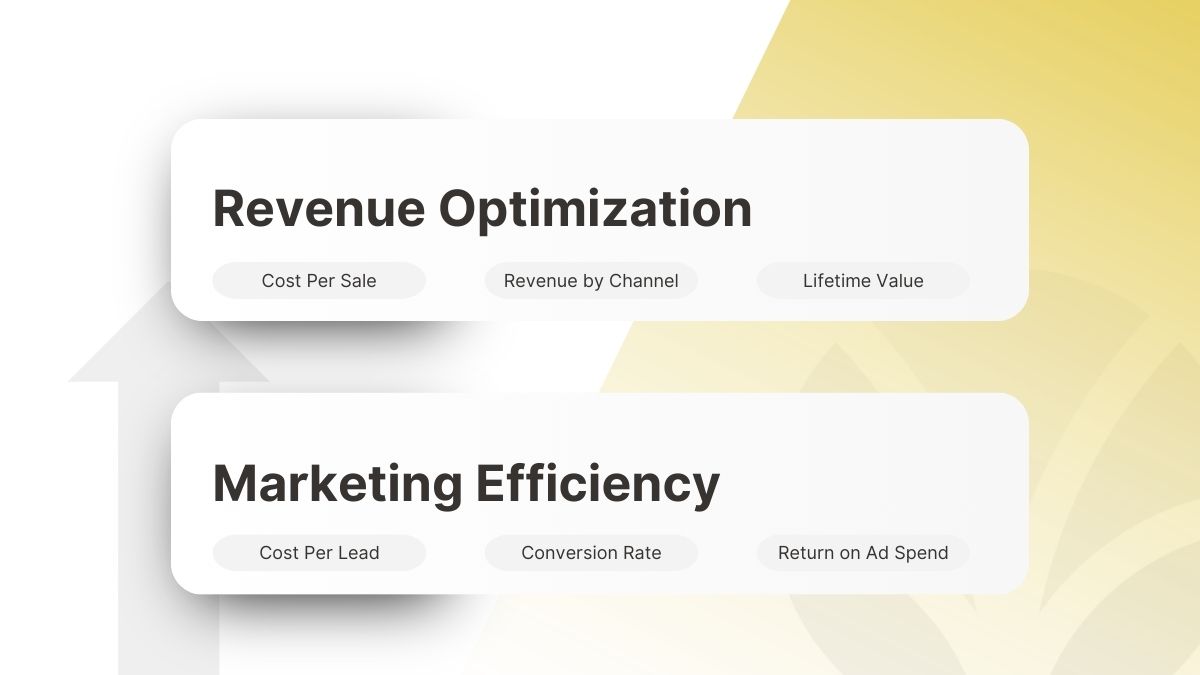
Performance marketing has become the standard for modern growth. Dashboards track cost per click, cost per lead, conversion rate, and return on ad spend in real time. Campaigns are optimized weekly, sometimes daily. Budgets are adjusted based on efficiency. On the surface, everything feels accountable.
But here’s the reality: many companies operating in performance marketing are only measuring half of what matters. There are two levels of marketing maturity, campaign efficiency and revenue optimization. Put in another way, one view asks, “How cheaply can we generate leads?” and the other asks, “How profitably can we grow the business?”
Both matter, but only one drives real growth.
Campaign Efficiency
Performance marketing agencies often focus on optimization inside the channel. It answers important operational questions like how much did we pay per lead? Which campaign generated the lowest cost per acquisition? Are we improving click-through rates? Is our return on ad spend trending in the right direction? And so on.
To put it simply, this level asks: “How cheaply can we generate leads?”
Metrics that help to determine marketing efficiency include:
- Cost per click (CPC)
- Click-through rate (CTR)
- Cost per lead (CPL)
- Cost per form submission
- Cost per phone call
- Conversion rate (landing page or campaign)
- Return on ad spend (ROAS) based on platform attribution
- Cost per acquisition (CPA)
- Impression share
- Engagement rate (for paid social campaigns)
- Lead volume by campaign or channel
These metrics measure how well marketing turns ad spend into conversions. They help reduce waste, improve targeting, and strengthen creative performance. They are essential for running disciplined, data-driven campaigns, but they stop at the point of conversion.
A campaign can deliver leads at a very low cost and still fail to drive meaningful business outcomes. If those leads do not convert into revenue, campaign efficiency does not translate into growth. That is why we are always asking our clients about lead quality every week. Optimizing cost per lead without connecting it to sales performance can create a false sense of success.
Revenue Optimization
With revenue optimization we move beyond campaign metrics and focus on business outcomes. This is where performance marketing becomes accountable to revenue, not just conversions. Revenue optimization metrics include:
- Cost per qualified opportunity
- Cost per sales appointment
- Cost per closed deal
- Revenue per lead
- Revenue per channel
- Pipeline value generated per campaign
- Win rate by source
- Average deal size by channel
- Customer acquisition cost (true blended cost)
- Customer lifetime value (LTV)
- LTV to acquisition cost ratio
- Time to close by channel
- Contribution margin by campaign
- Marketing-sourced revenue
- Marketing-influenced revenue
At this level, marketing efficiency is measured differently. Instead of cost per lead, the focus shifts to cost per qualified opportunity and cost per closed sale. Instead of platform-reported return on ad spend, the conversation turns to true marketing return on investment based on revenue recorded.
Revenue optimization efforts ask better questions. Which channels generate the highest lifetime value customers? How much pipeline value is created per dollar spent? What is the win rate by source? How long does it take for leads from each campaign to close?
This level requires structure, a clean source attribution in the CRM, and clear definitions between marketing-qualified leads and sales-qualified opportunities. Most importantly, it requires someone who owns the connection between marketing activity and revenue outcomes.
Campaign efficiency optimizes spend. Revenue optimization scales growth.
Why the Structure Matters
One of the most common issues we see is a reporting gap between marketing and sales. Marketing reports on leads and cost per acquisition. Sales reports on revenue and close rates. Leadership sees two different scorecards.
When that connection is missing, performance marketing can appear successful while overall growth stalls. The issue is rarely the campaigns themselves. It is the absence of structural accountability.
Organizations need a framework that includes consistent source tracking, accurate status progression from new lead to quoted to closed, and revenue values tied to originating campaigns. Without this structure, marketing efficiency remains limited to platform data rather than business impact.
The shift is not about more complex analytics, but rather a move towards ownership and alignment.
B2B vs. Ecommerce vs. Local Business
The way performance marketing connects to revenue will vary by industry, but the need for revenue optimization remains consistent.
For B2B lead generation companies, especially in manufacturing or professional services, the sales cycle can extend for months. A low cost per lead means little if those leads do not convert into qualified opportunities. In these environments, marketing efficiency must be measured against pipeline value and revenue generated over time. Cost per opportunity, win rate by channel, and long-term customer value become more meaningful than cost per form fill.
Ecommerce businesses operate on faster feedback loops. Performance marketing and marketing efficiency are often closely tied to return on ad spend and customer acquisition cost. However, even here, true growth requires looking beyond immediate revenue. Contribution margin, repeat purchase rate, and lifetime value determine whether marketing spend is truly efficient or simply driving unprofitable volume.
Local service-based businesses face a different dynamic. Calls and form submissions are only the first step. The real measure of marketing efficiency is cost per booked job and revenue per lead. Close rate by channel and revenue per service type often reveal which campaigns drive profitable growth versus surface-level activity.
Creating a Structure for Resource Optimization
Over time, we have developed, alongside our clients, several models that successfully connect performance marketing to revenue optimization. This isn’t an exhaustive list, but it creates and accountability mechanism to keep your teams moving towards revenue optimization with your performance marketing agency.
Agency + (Fractional) CMO
Here we manage campaign-level marketing efficiency while working closely with a fractional Chief Marketing Officer to improve attribution. In one example, we analyzed Google Click Identifiers stored in the CRM and matched them to Google Ads campaigns. That alignment allowed us to determine which campaigns generated actual sales rather than just leads. The collaboration strengthens revenue accountability without duplicating effort.
Full Access for Agency
In some cases, we are given direct visibility into the sales CRM. With accurate originating source data, we track channel return on investment monthly and update revenue reporting as deals move from quoted to closed. This creates a long-term view of marketing efficiency that reflects actual business impact rather than surface-level performance metrics.
Agency + Marketing Manager/Director
Sometimes we partner with an internal marketing manager who reports to senior leadership. Often, this includes helping them gather sales-side data and present a clearer narrative around revenue contribution. This structure elevates marketing from campaign reporting to strategic growth reporting.
Agency + Ownership/Leadership
Working directly with ownership and/or senior leadership, we work to improve how marketing effectiveness is measured. That may involve simplifying dashboards, standardizing reporting, and connecting marketing spend directly to revenue outcomes. When owners can clearly see which channels produce profitable growth, decision-making becomes more disciplined and confident.
The Real Evolution of Performance Marketing
Performance marketing is no longer just about clicks and conversions. The companies that win long term are the ones that connect marketing efficiency to real business outcomes. They optimize campaigns for maximum marketing efficiency, but they make strategic decisions based on revenue optimization.
Both levels matter. But if you stop at campaign metrics, you are only measuring activity. When you build the structure to connect marketing to revenue, performance marketing becomes what it was always meant to be: a measurable driver of growth.